Producing “The Music Man”

The Music Man Poster For Sale

The Music Man Poster

The Music Man By Meredith Wilson

GENRE: Musical

Performance length: about 2 and ½ hrs. with a 15-minute intermission.

ACTING: Easy

MUSIC: Medium

SET DESIGN: Medium

COSTUME DESIGN: Medium

CAST POTENTIAL: This play features a very large cast and music with a vast range. Some of the songs will require your best singers, while others rely more on rhythm than tune.

You can buy this artwork and use it for your own production of “The Music Man” click here

CROWD REACTION: This play has been wildly popular since it opened on Broadway in 1958. It has been revived on a countless number of professional and amateur stages and made into two films. More than a few songs have become immediately recognizable to an American audience, such as “Ya Got Trouble,” “Gary, Indiana,” “Seventy-Six Trombones,” and “Shipoopi.”

SUMMARY: Professor Harold Hill is a con man extraordinaire on his way to River City, Iowa, where he plans to sell the town a myriad of instruments and uniforms with the promise to teach the town children how to play in a band. However, Professor Hill has absolutely no intention to teach the children a single tune! While his fast-talking bravado seduces River City with ease, Professor Hill’s attempt to con River City becomes increasingly complex when he finds himself falling in love with the librarian, Marian. With a full order of instruments on their way, Professor Hill has two options: to leave town with the money or to stay with the girl and be caught a fraud.

CASTING CONSIDERATIONS: The two parts that are perhaps the most difficult to cast are the two leads, Professor Harold Hill and Marian Paroo. The role of Professor Hill is built around an actor’s talent to speak quickly, precisely and carry the stage with absolute magnetism. Brook Atkinson wrote of the original Professor Hill, Robert Preston, that his “’his expansive energy and his concentration on the crisis of the moment are tonic.” If an audience can simultaneously love and hate this man, be enraptured by his tunes but disgusted by his motives, then the central conflict of the piece will erupt in their imagination, for they are experiencing the same emotional struggle as Marian. Which is also why Marian is difficult to cast, for that actress needs to convey the same naivety and skepticism we feel in the audience (and have a good singing voice to boot).

SCENIC CONSIDERATIONS: The scenic design for The Music Man should capture the Midwest spirit of 1902 River City, Iowa. Tweed suits, overalls, and flowered dresses with frills abound! Like many musical comedies, this one features many settings (on a train, in a library, on the street) so an expressionistic set that suggests locales is best.

PERSONAL REFLECTIONS: The Music Man is a show with undeniable charm. While its plot is predictable, its characters silly, and its music overly-quaint, there is something about the pace and pull of this show that makes it an American classic. Perhaps the show’s legacy can be accredited towards its catchy tunes. There are so many foot-tapping and memorable songs packed into this little musical, perhaps more per-capita than any other show around. The setting of the piece, I think, also contributes a big part to the play’s success. Through celebrating the humdrum charm of small-town life, The Music Man is Americana through and through. And even in this small, rural town, the dream of Seventy-Six Trombones can become reality through the will and pride of its people.

Posted in Production Reveiw | Leave a comment

Producing “Noises Off”

Noises Off Poster for Sale

Noises Off Poster

Noises Off By Michael Frayn

GENRE: Farce

Performance length: about 3 hours and 15 minutes

ACTING: Hard

SET DESIGN: Hard

COSTUME DESIGN: Easy

CAST POTENTIAL: This play will stretch the comedic talents of your casting pool, requiring most of them to play not one, but two over-the-top characters.

You can buy this artwork and use it for your own production of “Noises Off” click here

CROWD REACTION: I have seen two different productions of this piece and both had the audience literally rolling in the aisles. “The Butcher of Broadway,” Frank Rich, called it “the funniest play written in my lifetime.”

SUMMARY: Written as a play-within-a-play, Michael Frayn wanted to show both sides of a theatrical farce: the onstage comedy and the offstage chaos. The first act is a dress rehearsal for the ridiculous sex-farce Nothing On. And, as the title suggests, nothing is going right. It is here we begin to see what terrible shape this production is in.

The second act takes place on opening night of Nothing On, except we are privy to watch the performance from backstage. While the actors run on-and-off stage to deliver their lines, we get to watch them fumble aimlessly backstage as they futilely try to maintain order.

The third act is closing night and the cast and crew have clearly lost all control of their play. We watch the first act of Nothing On once more and laugh at the denigration of a production that seemed destined to fail.

CASTING CONSIDERATIONS: This play requires a highly energetic cast with an exquisite sense in timing. Performing any farce can be very stressful and demanding, yet Noises Off takes those requirements to another level. Both the dialogue and staging are extremely complicated, demanding the actors to be many places in very little time. The second act, particularly, is an acrobatic feat. While the audience cannot see Nothing On, they can still hear it being performed. So, not only must the actors perform the hilarious backstage pantomime, but they must also catch their cues for the onstage play.

Be that this was written by a British playwright, the cast really needs to be able to execute that accent. The dialogue just doesn’t ring true without it.

SCENIC CONSIDERATIONS: Like any farce, the set usually becomes a character in itself. Doors are usually the bread and butter of a high stakes comedy. The more entrances and exits, the better. Here, the set not only features many, many doors, but must be able to rotate 180-degrees to expose its backstage. I have seen this executed with a massive box-set (most impressive) and unit pieces (got the job done, but less exhilarating). In either case, this requires a lot of foresight and planning, but is a delightful treat for the audience.

PERSONAL REFLECTIONS: I echo Frank Rich’s sentiments. This is one of the funniest plays I have ever seen. And even though the performance length is a daunting 3 hours and 15 minutes, the time seems to fly by. As a theatre person, I find much of the comedy very relatable: the vices and personalities of the cast can be found in almost any theatrical company. Yet I think the audience member who knows little about the process of a theatrical production will find this play that much more enjoyable, because it shows everything we theatre makers try desperately hard to hide: that is, the noises off.

Posted in Production Reveiw | Leave a comment

Musicals for 2010 – 2011

We completed our Musical poster designs for the 2010-2011 season. We’re really proud of this set of work. All are available for purchase for your own theater productions of these popular stage plays. Just click on any image and you’ll find the purchasing options. Continue reading

Posted in Update | Leave a comment

Producing “God’s Favorite”

God's Favorite Poster and logo for sale

God's Favorite

God’s Favorite by Neil Simon

Performance length: about 2 hours with one intermission

ACTING: Easy

SET DESIGN: Medium

COSTUME DESIGN: Easy

CAST POTENTIAL: Neil Simon’s plays almost guarantee a wide variety of broad, colorful and witty characters; each with an opportunity to steal a scene or two. This play is no exception.

CROWD REACTION: Based on the Job parable in the Old Testament, this play presents an old story in a bright and funny package. It’s filled with Simon’s iconic brand of humor, sure to bring the audience (and laughs) rolling.

GENRE: Drama

You can buy this artwork and use it for your own production of “God’s Favorite” click here

SUMMARY: Joe Benjamin has it all: an adoring (if not all that bright) family, a luxurious home on the North Shore of Long Island, and a box factory that earns him millions. He credits all he has to his love for God.  However, when Sidney Lipton (a messenger from God of the Jack Lemmon/ Woody Allen variety) appears, he informs Joe that God and Satan have made a wager, whereby God informs Satan that no amount of suffering would ever lead Joe Benjamin to renounce his faith.

Incredulous, Joe insists that he would never renounce God, no matter the circumstance. But this bold proclamation leads to a series of unfortunate events that involve the utter destruction of his factory, the collapse of his home, and the disintegration of his health. Not only does this test Joe’s resolve for God, but his family’s resolve for Joe.

CASTING CONSIDERATIONS: The cast is relatively small, consisting of eight parts (4M, 4W). Most of the dialogue is dominated by Joe and Sidney, but Simon has included enough moments to make the minor characters an integral part of the script. There are two black servants, Mady and Morris, but why these characters have to be portrayed by black actors is not evident. In fact, casting these characters as black could be perceived as insensitive, at best. This is not a period piece, nor does it need to be produced as one.

SCENIC CONSIDERATIONS: The scenic elements are perhaps the biggest challenge facing a cast and crew because of the transformation that happens halfway through the text.  In the opening scene, Simon describes a fabulous house featuring large oak doors, paintings, leather-bound books, and ornate furniture. But in Act Two, the house is a dilapidated skeleton, “burnt to the ground.”  The characters clothes are “tattered and singed,” and Joe suddenly looks old and aged.

The audience needs to see this dramatic contrast to understand the extent of Joe’s suffering. Simon even titles Act Two as “the Holocaust after.” Without a doubt, creating a set as beautiful and refined in the first act, and equally as ruined in the second, is a difficult task that requires a large budget or a creative and economical set designer.

PERSONAL REFLECTIONS: Woody Allen said, via the character Lester in Crimes and Misdemeanors, “If it bends, it’s funny. If it breaks, it is not funny.” Simon illustrates the careful balance between comedy and tragedy through this play, where he has turned one of the most troubling and depressing books of the Old Testament into a modern, comedic romp. His script is laced with irony, where misery elicits laughs, not sympathy.  And though Joe suffers tremendously, his trials pale in comparison to his biblical counterpart.

So, while this play is rich with philosophical and religious potential, Simon does not reach deep; he simply uses the myth of Job as a framework for slapstick. He bends, but only so much. Therefore, it is up to the director to bend things even more, to bend the play until the audience is ready to believe Joe may give up, to bend until Joe’s faith just about breaks.

For another classic play based on Job, consider the Pulitzer Prize winning J.B. written in verse by Archibald MacLeish. Performing these plays in repertory may be a fascinating exploration is style and tone.

Posted in Production Reveiw | Leave a comment

Producing “12 Angry Men”

12 Angry Men Poster and logo for sale

12 Angry Men

12 Angry men by Reginald Rose

Performance length: about One Hour and 45 minutes, no intermission.

ACTING: Medium

SET DESIGN: Easy

COSTUME DESIGN: Easy

CAST POTENTIAL: As the title suggests, this play is made up of 12 disparate men who form a jury at a criminal trial. Though, because of the anonymity of the jurors (they are all called by their respective numbers), many directors have successfully made room for female actors by adjusting the title (12 Angry People/Jurors/Women).

CROWD REACTION: The play was originally written as a 50-minute live teleplay that was later turned into a 90-minute film with Henry Fonda. The stage play was written just a few years after the film, and it has since had countless revivals. Even though many things about the text are dated (the lack of gender diversity being one of them), the themes and issues in the play have made it relevant for generations.

GENRE: Drama

You can buy this artwork and use it for your own production of “12 Angry Men” click here

SUMMARY: 12 men have been called to serve their civic duty: in this case, to determine whether a young Puerto Rican boy had, beyond a reasonable doubt, murdered his father. When the jury initially votes, only Juror #8 declares the boy “not guilty.” Even though there is a great deal of circumstantial evidence to suggest the boy is guilty of murder, #8 decides to vote against his 11 peers because “it’s not easy for me to raise my hand and send a boy off to die without talking about it first.”

Systematically, one by one, the jurors discuss the facts evident in the trial and discover that each are suspect when under close scrutiny. Furthermore, through the dialogue we discover the personal (and subconscious) motivations behind each juror: classism, racism, laziness, or deep emotional scars hinder some of the most obstinate jurors from viewing the case objectively. By the play’s end, Juror # 8 is able to sway the rest of his peers and the boy is acquitted.

CASTING CONSIDERATIONS: This play is more about the individuals in the jury room than it is the murder case. Each character deals with their own personal biases, each seeking different answers to the same questions.  The cast’s challenge is to convincingly show each character’s journey, from one distinct choice to another, in order for the outcome of this play to be believable.

While there are no “heroes” or “villains” per se, Rose has constructed the play in such a way that we identify with some characters more than others. Juror #8 is the play’s clear protagonist, a selfless icon of liberal compassion and defender of the democratic process. Meanwhile, Juror #3 is an intolerant, difficult, and demanding entrepreneur, whose embittered past with his son has tainted the way he views the case. His is the hardest and last vote to be swayed.

SCENIC CONSIDERATIONS: Rose said one of the major elements he wanted to include in the play were physical problems such as the atmosphere of an uncomfortable, cramped room with little ventilation and hard, unforgiving chairs. The Henry Fonda film does an excellent job creating this atmosphere. But a stage play has the advantage of more depth and a fully-visible ecology (that is, the placement and proximity of things on stage). The physical problems can be brought to the forefront with a clever manipulation of dimensions and special relationship.

The characters personalities and background are indicated to the audience more by their dress and mannerisms than anything else. There is a stockbroker, an architect, a salesman, who all wear jackets and ties; accompanied by a high school football coach, a mechanic, and a house painter, who each wear open collars. Since the cast is literally stuck on stage for the entire play and are under the careful scrutiny of the audience the whole time, small subtle cues in dress can go a long way.

PERSONAL REFLECTIONS: Both an indictment and defense of the American judicial system, Twelve Angry Men challenges the authenticity and integrity of those 12 individuals whose opinions and choices result in absolute (and often devastating) consequences.  If Juror #8 was not in the room, the Puerto Rican boy would have most likely been sentenced to death.  Yet, he was there. And the power of his rhetoric was enough to sway the opinions of 11 strangers.  All Juror #8 achieved to do, however, was prove that there was “reasonable doubt” about the boy’s guilt.  He never proves that the boy did not kill his father.  So, the audience is left to reconcile whether or not #8’s liberal values and scrutiny were actually beneficial. If the boy was not guilty, then #8 has saved an innocent life. If the boy was actually guilty, however, then a murderer has been acquitted.   It is this dichotomy that challenges how delicate and precarious our judicial system really is.

Posted in Production Reveiw | Leave a comment

Producing “Into the Woods”

Into the Woods Poster and logo for sale

Into the Woods

INTO THE WOODS Music and Lyrics by Stephen Sondheim; Book by James Lapine

Performance length: about 2 and ½ hrs. with a 15-minute intermission.

ACTING: Easy

MUSIC: Hard

SET DESIGN: Hard

COSTUME DESIGN: Medium

CAST POTENTIAL: The cast is composed of several familiar fairy tale characters, such as Little Red Riding Hood, Jack (and his milk cow), Cinderella, Rapunzel, an evil witch, a charming prince, and a hungry wolf.  While some roles are larger than others, the cast is by and large an ensemble.  Each character has an opportunity to shine.

CROWD REACTION: One part familiar, the other strange and inventive, Into the Woods challenges our most cherished stories in an engaging way, making it very appealing for audiences.

GENRE: Musical

You can buy this artwork and use it for your own production of “Into the Woods” click here

SUMMARY: Based on several Brothers Grimm fairy tales, the first act is a veritable collage of our most familiar fairy tale characters, weaving together their trials.  The string that ties all these stories together is the Baker and his wife, who have been cursed from having children by the ugly old Witch.  However, the Witch says the curse will be lifted if the two can find the ingredients for her potion: “the cow as white as milk, the cape as red as blood, the hair as yellow as corn, and the slipper as pure as gold.”  By the first act’s end, the Baker is successful, the Witch drinks the potion and turns young and beautiful, and all the characters earn their greatest wish.

Where most fairy tales end, Into the Woods continues.  It shows how the characters did not live “happily” ever after, that their greatest wishes turned hollow, and that the happiness they sought is still lost.  To make matters worse, a Giant has come crashing down from the heavens and threatens to destroy land unless they can offer Jack as a sacrifice.  The characters must work together to purge the Giant while battling the moral dilemmas that haunt them at every turn.

CASTING CONSIDERATIONS: This is an exciting musical for any casting pool for the sheer breadth of opportunities it affords. There are plenty of juicy roles here, lots of comedy, and a fantastic score.  However, it should be noted that Sondheim’s syncopated and complex musical style is in full force.  As exciting and fun as the music is, it is very difficult and dominates most of the text. Into the Woods verges closely towards operetta.  Make sure you have the singing talent to carry this piece.

SCENIC CONSIDERATIONS: As a tapestry of fairy tale stories, the musical demands a flexible set: one that can at once show the Baker’s house, Rapunzel’s tower, or the titular woods. Costumes are equally as varied. The text also calls for a mobile cow, the Witch’s spectacular onstage transformation, growing beanstalks, and a Giant’s falling corpse.

OTHER CONSIDERATIONS: Like many of the musical’s charming characters, it has two sides.  At once funny, adventurous, and whimsical, Into the Woods can be equally dark, challenging and perverse.  The second act is filled with mature content that may not be acceptable for a high school audience, including infidelity, lust, and murder.  Ultimately the play’s central message is directed towards adults, to be mindful of children – the stories you tell are the ones you live and “children will listen.”

PERSONAL REFLECTIONS: Before there was Wicked, there was Into the Woods. The two focus on postmodern themes — discriminating authority while espousing the virtues (and elusiveness) of personal truth – through an investigation of popular stories and myths.  No one sews entertainment and philosophy as seamlessly as Sondheim, which is what makes this musical so alluring. Its ability to deliver profound questions through engaging dramaturgy makes us pause in wonderment, as if we were children listening to the Grimm stories for the first time.

Posted in Production Reveiw | Leave a comment

Producing “Our Town”

Our Town Poster and logo for sale

Our Town

Our Town by Thornton Wilder

Performance length: about 2 and ½ hrs. with a 15-minute intermission.

ACTING: Hard

MUSIC: Easy

SET DESIGN: Easy

COSTUME DESIGN: East

CAST POTENTIAL: This play is composed of a large cast of archetypal characters (fathers, daughters, mothers, sons, and one stage manager). Given that there is no scenery and only a few props, even the smallest part plays a huge role in creating the “world” on stage.

CROWD REACTION: Over 70 years old, this plays style and structure are still perceived as groundbreaking and unique. In an age where spectacle and scenery have dominated the American stage, audiences find the simplicity and directness of this play refreshing.

GENRE: Drama

You can buy this artwork and use it for your own production of “Our Town” click here

SUMMARY: Earning Wilder his first Pulitzer Prize in Drama, Our Town is set in a theatre where the Stage Manager tells us we are to watch a play written by Thornton Wilder about a New England town called Grover’s Corners. As the title suggests, this town is supposed to be representative of all America; its story similar to our own.

The play is composed of three acts: “Daily Life,” “Love and Marriage,” and “Death and Eternity.”  The first depicts a typical morning between the Gibbs’ and Webbs’ homes. It is here we first detect a romance between George Gibbs and Emily Webb. The second act illustrates the development of George and Emily’s relationship and ends with their marriage. The final act takes place in a cemetery where Emily watches her own funeral (she dies delivering her second child). Despite the admonition from the other dead, Emily chooses to re-live one day of her life, her 12th birthday.  Feeling a mixture of bliss and grief as she watches her old life, she asks the Stage Manager, “Do any human beings ever realize life while they live it? – every, every minute?” To which the Stage Manager simply replies, “No. The saints and poets, maybe – they do some.”

CASTING CONSIDERATIONS: Because it is routinely performed without any set and only a few prop pieces, this play can be very demanding for young actors who have to establish the entire world with their careful and precise pantomime.

Another cautionary quality of this script is its inherent sentimentality. The play’s final act, especially, invites a mournful, maudlin tone (after all, the act’s main character, Emily, is dead). But actors should resist the temptation to play into this sentimentality. Played simply, truthfully, the emotion of the text will carry through without any additional quivering and weepiness from the cast. Executed well, this play will illustrate the maturity and control of your cast.

SCENIC CONSIDERATIONS: Wilder’s dramaturgy highlights the essential qualities of the theatre: the actors, the audience, and the stage. Nothing more.

However, a recent production of Our Town in New York City, brilliantly directed by David Cromer, broke this convention of the play be reverting to complete naturalism in the final act. When Emily decides to revisit her 12th birthday, the curtain at the back of the stage was pulled aside, revealing a fully-adorned set, complete with furniture, walls, and a working stove (the audience could actually smell bacon cooking). Cromer’s “twist” destabilized the audience’s expectations based on the preconceived and historical performance of Wilder’s text. It made the play’s final moments that much more heartfelt and painful. Cromer’s vision is a perfect example how to break the playwright’s wishes while still honoring the heart of his play.

PERSONAL REFLECTIONS: Edward Albee complains that most productions of Our Town miss the point. They present it like a “Christmas card” without acknowledging how cutting and existential the play truly is. Wilder was trying to reconstitute that life is both fragile and ephemeral. If the play appears “sentimental,” it is because our perception of memory, family, love, and death are sentimental. But sentimentality is the result of a good performance, not the quality of it.

Posted in Production Reveiw | Leave a comment

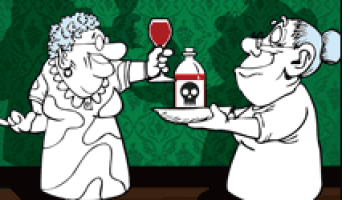
Producing Arsenic & Old Lace

Arsenic & Old Lace Poster and logo for sale

Arsenic & Old Lace

By Joseph Kesselring

Performance length: about 2 1/2 hrs. with a 15-minute intermission.

ACTING: Easy

SET DESIGN: Medium

COSTUME DESIGN: Easy

You can buy this artwork and use it for your own production of “Arsenic & Old Lace” click here

SUMMARY:
Abby and Martha Brewster are Brooklyn’s most charitable sisters. They feed the hungry, give to the poor, devote themselves to the church, and poison lonely old men.  When their nephew Mortimer, a famous theatre critic, discovers a body from their most recent act of benevolence, he becomes distraught and immediately tries to remedy the situation (this involves breaking up with his fiancée, Elaine). The sisters, without an ounce of guilt, try to calm Mortimer and inform him that the bodies (all 12 of them) are neatly buried in the cellar.

To make matters worse, the Brewsters are visited by Mortimer’s murderous brother, Jonathan, and his oafish henchman, Dr. Einstein (no, not THAT Einstein).  Jonathan schemes to make the Brewster’s house the new base for his criminal activity and even attempts to blackmail the family upon discovering the bodies downstairs.  Mortimer is faced with saving his family while keeping his aunts free from incarceration.

CASTING CONSIDERATIONS:
Similar to The Man Who Came to Dinner or You Can’t Take It With You, this plays boasts a large cast (11M, 3W) of outlandish characters. Many of the minor roles, such as the police officers, can be cast as women.

Beyond the two sweet sisters, who are completely naïve they are committing a heinous crime, the play also consists of their nephew Teddy, who actually believes he is Teddy Roosevelt; the hulking Jonathan, who resembles Boris Karloff; Dr. Einstein, who was perfected by Peter Lorre in the Frank Capra film adaptation; and a bumbling police officer, who aspires to be a playwright. This broad cast of characters is balanced by the relatively hard-nosed pragmatics of Mortimer and the charm and beauty of Elaine.

SCENIC CONSIDERATIONS:
One of the most memorable qualities of this play is its set, which boasts several entry ways and one pivotal staircase. Described as “Victorian as the two sisters,” this set is central to the development of the story and much of the play’s comedy. The architecture of the house serves as an additional obstacle for the characters who run to and from the living room, climb up and down the stairs, and fall in and out of the large window.

Costumes should be period (1940s) garb.

OTHER CONSIDERATIONS:
There is no secret as to why this play is so widely performed. Kesselring commits a remarkable balancing act with each of these characters, giving them all time to develop and grow on stage, while structuring a plot which twists and tightens with each passing moment. Though, the script’s greatest flaw is in its resolution, where the playwright opts for cheap humor and a random cavalcade of police men to save the day (Kesselring justifies this through Teddy, whose bugle horn infuriates the neighbors). The audience, however, will probably be very forgiving here because the play provides an enjoyable story with such gratifying comedy.

Posted in Production Reveiw | Leave a comment

Plays for 2010-2011

We completed our Play poster designs for Fall 2010. We’re really proud of this set of work. All are available for purchase for your own theater productions of these popular stage plays. Just click on any image and you’ll find the purchasing options. Continue reading

Posted in Update | Leave a comment

Producing Grease

Grease Poster and logo for sale

Grease

Music, Lyrics, and Book by Jim Jacobs and Warren Casey
Performance length: about 2 and ½ hrs. with a 15-minute intermission.

ACTING: Easy

MUSIC: Medium

SET DESIGN: Medium

COSTUME DESIGN: Medium

CAST POTENTIAL: Set at the fictional Rydell High School, this play is an excellent vehicle to boast the talents of a high school aged cast.

CROWD REACTION: This popular stage musical, made even more popular by the iconic 1978 film starring John Travolta and Olivia Newton-John, features catchy songs such as “Summer Nights,” “Grease Lightning,” and “You’re the One that I Want,” which have delighted audiences for almost 40 years.

GENRE: Musical

You can buy this artwork and use it for your own production of “Grease” click here

SUMMARY:
It’s 1959. Summer vacation is over and the students at Rydell High School begin lamenting the advent of another school year, when suddenly Sandy and Danny each tell their friends about a torrid summer love affair they shared together (Sandy focusing about the romantic side; Danny about the physical) that ended unresolved in the song “Summer Nights.”

When the two bump into each other at school, Danny “plays it cool” in front of his friends, the T-Birds: a rag tag group of “greasers” who don tight jeans, leather jackets, and talk about nothing but cars, girls, and cigarettes. The shy and innocent Sandy, hurt and dejected, soon discovers that if she is to get Danny in the end, she will have to transform into a “greaser” herself. Impressed by her final transformation, Danny becomes desperate for her attention, and the two sing “You’re the One That I Want.”*

* This song was not in the original stage version of Grease, but added later due to the popularity of the film.

CASTING CONSIDERATIONS:
Given that this play is set in a high school, the play lends itself to high school aged actors who could probably relate with many of the characters they are portraying. True, this play is set in 1959, and the high school culture was far different back then. But the themes these characters face – fitting in, finding love in unexpected places, and social issues, such as sex, smoking, and drinking – are timeless. It’s also exciting for the cast to portray these teenagers from the past, to live and speak as perhaps their parents did when they were in high school.

Because of the film, casting for Sandy and Danny have been guided by the patterns set by Olivia Newton-John and John Travolta. Ergo, Sandy usually has big, curly blonde hair, while Danny is tall with dark, slicked back hair. I encourage directors to feel free to break from this mold, to find actors who can offer more than an impression of these two stars. Casting a unique Sandy and Danny is the start to creating a fresh and invigorating production of Grease.

Beyond Sandy (the ingénue) and Danny (the tall, dark, and handsome rebel), this play boasts a bevy of dynamic characters and chorus rolls that will offer your casting pool a great deal of opportunity. Noteworthy are Rizzo, the loud-mouth and sarcastic leader of the “Pink Ladies” (the female equivalent of the “T-Birds”), Kenickie, Danny’s rough-and-tough second in command (who fears that he has impregnated Rizzo), and Roger, who croons about “mooning” to his girlfriend Jan.

SCENIC CONSIDERATIONS:
This play is a time-capsule, both honoring and mocking the fashion and trends popular in 1959. The guys wear tight jeans, white shirts, and leather jackets, while the girls can be seen wearing bright, lacey poodle skirts. Checkered linoleum usually adorns the stage along with bright-neon colors. These costume and scenic elements are not just characteristics of the Fifties, but are hallmarks of Grease itself.

OTHER CONSIDERATIONS:
When it first came out, the musical garnered attention for being raunchy and offensive. There is a lot of validity to those accusations. Teenagers smoke, drink, have sex, and, at one point, Rizzo even thinks she’s pregnant. These are mature themes, indeed. Furthermore, many of the songs, namely “Grease Lightning,” contain explicit sexual double entendre – in this case, comparing a woman’s body to a car. However, Grease as a whole presents these issues in a light, comedic package that make the characters’ iniquities more endearing than offensive.

PERSONAL REFLECTIONS:
Grease is a hilarious musical comedy that has stood the test of time namely because it has captured the essence of a generation. Furthermore, it managed to blend the style and architecture of a Broadway musical comedy with the teenage angst comedies – such as American Graffiti – that have since become incredibly popular for the American public. For these reasons alone, Grease deserves its privileged status as one of the most popular musical comedies to date.

Posted in Production Reveiw | Leave a comment